

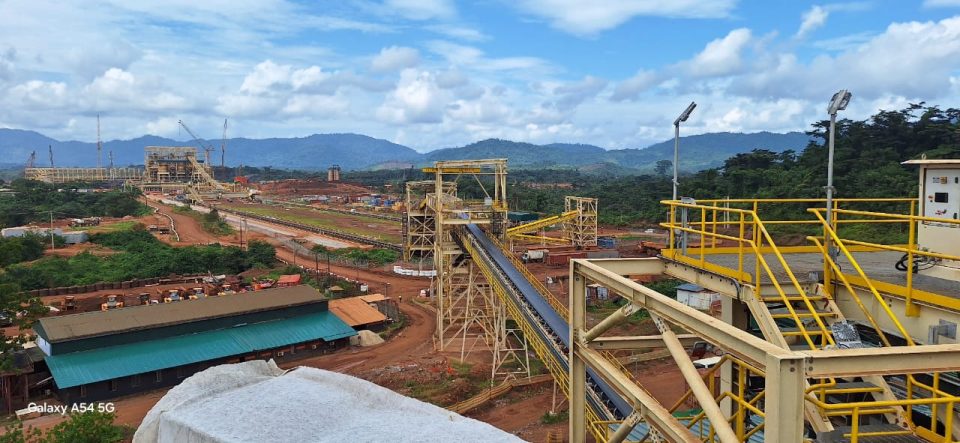
Yekepa, Liberia: An iron ore concentrator is a processing facility that upgrades raw iron ore by increasing its iron content while removing impurities like silica, alumina, and other non-ferrous materials. The objective is to produce a high-quality concentrate suitable for steelmaking.
At the heart of ArcelorMittal Liberia’s ambitious 15 million tonnes per annum (Mtpa) project lies a state-of-the-art concentrator plant. Purposefully designed for operational efficiency, scalability, and environmental responsibility, this facility uses staged magnetic and gravity separation processes to produce a high-grade wet concentrate.
Future-ready, the plant can be expanded to process harder transition ores with minimal modifications—enabling a potential shift to a -1.0 mm coarse concentrate. The inclusion of a coarse tailings dewatering system allows for dry stacking, significantly reducing the tailings storage footprint and overall costs.
Operational Design and Availability
- Annual Operational Hours: 85.5% of total hours (7,490 hrs/year)
- Planned Maintenance: 10% (876 hrs/year)
- Weekly: 8 hrs/week
- Monthly: 16 hrs/month (combined with weekly = 24 hrs once a month)
- Annual Shutdown: 5-day shut totaling 120 hrs
- Ad hoc: 172 hrs/year
- Breakdowns: 5% allowance
- Planned Maintenance: 10% (876 hrs/year)
- Raw Ore Throughput: 22.68 Mtpa (wet) → 3,028 tph (wet)
- Final Product Output: 15 Mtpa (wet) → 2,003 tph (wet)
- Coarse Rejects: 4.23 Mtpa (wet) → 564 tph (wet)
- Fine Rejects: 3.73 Mtpa (wet) → 499 tph (wet)
- Total Rejects: 7.96 Mtpa (wet) → 1,062 tph (wet)
Concentrator Process Description
The concentrator plant is structured into the following key areas:
- SAG Milling (Area 3410)
- Concentration (Areas 3420, 3430)
- Concentrate Dewatering (Area 3440)
- Tailings Disposal (Area 3450)
- Ancillary Areas (Areas 3460, 3920)
Each of the three identical 5 Mtpa process lines is designed for sprint capacity, while common services like thickening and conveying systems are shared.
1. SAG Milling (Primary Grinding)
Crushed ore is introduced into SAG mills via feed conveyors. Oversized material is diverted to a tramp bin, while undersized ore passes through double-deck screens. The process uses a state-of-the-art monitoring system to handle the variable size distribution caused by friable oxide and transition ores, ensuring stable mill performance and protecting liners from damage.
2. Concentration
A combination of gravity and magnetic separation is used to upgrade the ore:
- Gravity Circuit (1.1 mm to 100 µm):
- Cyclone underflow feeds multi-deck vibrating screens that split feed into coarse and fine fractions.
- Both are processed in REFLUX Classifiers, which use laminar shear and elutriation water to separate dense iron particles from lighter gangue.
- Iron-rich concentrates are sent to pan filters; tailings go to coarse tailings dewatering.
- Fines Magnetic Circuit (<100 µm):
- Overflow from cyclones enters LIMS (Low-Intensity Magnetic Separators) for bulk separation.
- Remaining fines are treated in REMS (Rare Earth Magnetic Separators) after thickening in hydro-separators.
- LIMS and REMS concentrates are combined and directed to the concentrate thickener; tails are routed to the tailings thickener.
3. Concentrate Dewatering
- Coarse Concentrates from REFLUX classifiers are dewatered using pan filters, which vacuum excess water from the filter cake before transfer to stockpiles.
- Fines Concentrates are thickened and filtered using ceramic filters that achieve moisture content ≤ 8%.
- Filtrates from both systems are recycled, while filter cakes are stored in the concentrate stockyard. Periodic acid cleaning ensures ceramic filter efficiency.
4. Tailings Disposal
- Coarse Tailings are dewatered via cyclones and vibrating screens, creating a sand-like product for haulage disposal.
- Overflow and underflow from dewatering are directed to thickeners, which recover water for reuse and prepare dense tailings slurry for storage.
Conclusion
This concentrator stands as a benchmark for technical efficiency, modular scalability, and sustainability. By integrating advanced separation technologies with a well-engineered maintenance plan and environmental foresight, ArcelorMittal Liberia’s 15 Mtpa concentrator is more than a processing plant—it’s a cornerstone of Liberia’s industrial future.
